Textiles & care
Linen Fouta Towels: Weave, Absorbency, and Everyday Uses
Airy, tactile and quietly versatile, a linen fouta moves easily between the bath, the beach and the weekend bag. Its performance depends on more than fiber alone: weave, weight, construction and care all shape how it feels and functions.
Published November 16, 2026
A good towel earns its place through repetition. It is reached for after a shower, folded into a travel bag, spread over a warm stretch of sand or kept close at hand for the small rituals that make a day feel considered. The linen fouta is particularly suited to this kind of flexible life. Often lighter and flatter than a conventional plush bath towel, it brings a woven, breathable character to familiar routines without asking to be reserved for one room or one occasion.
That versatility can make the category seem simple at first glance. But a towel’s feel and usefulness are shaped by details: the structure of its weave, the weight of its cloth, the finish applied to the fiber and the way it is washed and dried. A linen fouta may be an appealing choice for someone who values a compact textile, while a heavier terry towel may better match a preference for a deep, cushioned feel. Neither is inherently the superior option. The useful question is how each construction suits the routine it is expected to serve.
This guide looks closely at linen fouta towels, from absorbency and drying behavior to practical uses at home and away. It also considers what product descriptions can—and cannot—tell you, including why a named weave or a weight specification is most helpful when read alongside the towel’s intended use.
What is a linen fouta?
A fouta is a woven towel commonly associated with bath, spa and hammam settings. Contemporary versions are made in different fibers and constructions, so the name alone does not guarantee a particular texture, thickness or performance. A linen fouta is one made from linen, a fabric spun from flax fibers. Its surface is typically woven rather than formed into the dense, raised loops familiar from terry cloth.
That distinction changes the experience. A flat or relatively low-profile woven towel tends to fold neatly and occupy less room than a bulky towel of comparable dimensions. The cloth can feel more textured, and its drape may be closer to a lightweight wrap than to a plush bath sheet. Some towels described as foutas use a sateen weave; others may have a waffle, plain or differently textured construction. Product details matter more than the broad label.
Linen also has a characteristic hand. It can feel crisp or cool when new, then become more pliable with use and washing. The fiber’s natural irregularities may remain visible as subtle variations in surface and drape. Rather than reading as a flaw, that unevenness is part of linen’s particular visual language: composed, but never quite uniform.
How weave shapes a towel
Weave describes how lengthwise and crosswise yarns interlace to form cloth. It influences a towel’s surface, structure and feel, but it should not be treated as a stand-alone promise of performance. Fiber, yarn, density, finishing and dimensions all contribute. Two towels made from linen can behave differently if their constructions and weights differ.
Flat-woven and sateen surfaces
A flat-woven towel has a relatively smooth, compact surface compared with terry. This can make it easy to fold and convenient to pack. A sateen weave, where the surface arrangement allows more yarn to appear on the face of the cloth, is often described as smooth or lustrous. In a linen towel, the weave may lend a more refined hand while preserving the recognizable texture of the fiber.
Some linen fouta descriptions specify a sateen weave and a washed finish. The wash can help give the fabric a softer, more relaxed feel from the outset, though the exact result depends on the maker’s process. For example, the Belgian linen fouta towels described in this collection are made from 100% linen, have a washed finish and use a sateen weave. The 43-by-71-inch Mercurio stripe version is presented as a multipurpose towel for beach, bath and everyday use. Its listed care guidance recommends washing at no more than 40°C, preferring line drying and using medium heat if a tumble dryer is chosen.
Waffle weave and relief
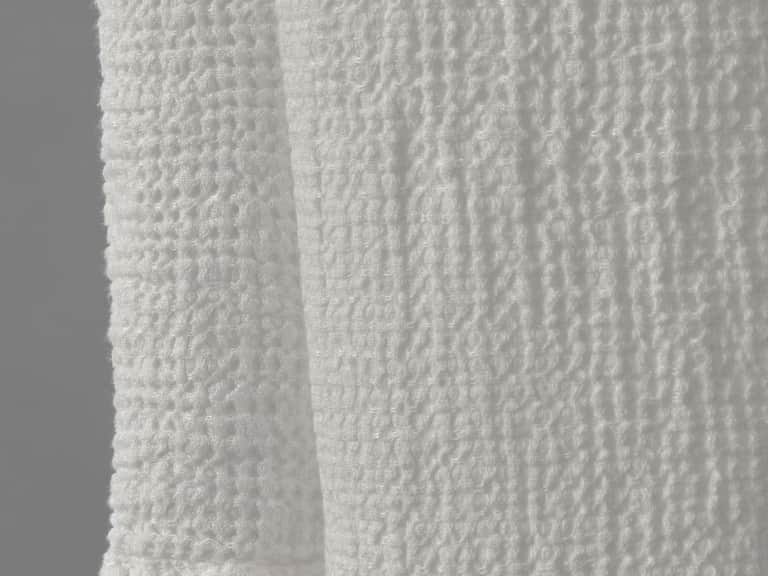
Waffle cloth has a three-dimensional grid-like surface. The raised and recessed areas create texture and can help the towel feel light rather than densely packed. That structure is different from the smoother face of a sateen-woven fouta, even when both are made from linen. A textured towel may feel pleasantly tactile and dry quickly in a well-ventilated space, but weave alone does not establish an exact drying time or absorbency level. Room conditions, towel thickness and how thoroughly it is aired all matter.
The Lipe New Bath Towel is a useful example of a linen towel with a distinct, non-fouta construction. It is made from 100% linen in a three-dimensional waffle weave, weighs 230 g/m² and is described as absorbent, easy-drying and hard-wearing. Its texture offers a different feel from a flatter fouta and may appeal to someone who wants visible relief and a more defined surface. Explore the Lipe New Bath Towel for its material and construction details.
Absorbency: what to expect from linen
Absorbency is one of the first questions people ask about linen bath towels, and rightly so. A towel’s central task is to take up moisture from skin. Linen is commonly valued for its ability to absorb moisture while remaining relatively light, but the experience is influenced by the specific textile. A dense, looped terry towel and a flat-woven linen fouta are not designed to feel the same in use.
With terry, loops create a soft, elevated surface that gives the towel a familiar cushioned contact. A woven linen fouta usually has a flatter profile, so it may feel less plush and more direct against the skin. It can still be a practical drying layer, but the sensation is different: less enveloping, more streamlined. Anyone accustomed to thick cotton terry may need a little time to appreciate the lighter hand.
Weight is one clue when comparing towels. It is often expressed in grams per square metre, or g/m². A lower number generally signals less material per area, while a higher number indicates a heavier cloth. Yet weight does not provide a complete verdict on absorbency. Fiber quality, yarn, weave, finishing and dimensions affect the result, and a heavier towel is not automatically the best choice for every routine.
When reading a product description, look for material composition, weave, stated weight and care instructions together. Be cautious of broad claims that treat a single specification as proof of superior performance. If a description does not state a towel’s weight or exact construction, do not assume those details. A thoughtful choice starts with the features that are actually documented and with your own preference for texture, thickness and drying feel.
Why drying behavior matters
How quickly a towel dries after use is as relevant as how it feels in the moment. A flatter towel is generally less bulky to hang and store than a thick terry bath sheet, which can be useful in a small bathroom, a shared home or a travel kit. Airflow, humidity, the spacing of towels on a rail and the warmth of the room also influence drying. No textile can be expected to dry at the same rate in every setting.
For everyday use, hang a linen towel fully open rather than leaving it folded over itself in a dense bundle. Give it enough space for air to circulate, and let it dry completely between uses. This simple habit supports freshness and avoids leaving damp fabric crowded on a hook. In a humid bathroom, ventilation becomes especially important; opening a window or running an extractor fan may help the room, not just the towel, dry more effectively.
A fouta’s compactness can be especially helpful on the move. It folds into a smaller bundle than many plush towels and can be useful when luggage space is at a premium. A lighter pack does not necessarily mean the towel is right for every traveler, however. Consider whether you prefer a thin, versatile layer or a thick, cocooning towel, and check dimensions before relying on it as a full-body wrap.
From the bathroom to the beach
The charm of a linen fouta lies in its ability to cross settings without feeling out of place. At home, it can be a bath towel or a spare layer for guests. By the water, it can serve as a towel, a light wrap or a surface to sit on. During travel, the same fabric can be folded into a bag for use at a pool, spa or beach. A generous fouta may also work as a casual throw over a lounger, though a towel’s suitability for that use depends on its size and the care you want to give it.
For the beach, a woven towel’s relatively slim profile is a practical advantage: it takes up less space in a tote and can be easier to shake out than a thick, looped towel. Sand may still cling to any textile, so shake the towel outside before bringing it indoors and follow its care label after a day in salt or sun. Rinsing off sand and salt promptly can help keep grit from being carried into a laundry load.
At a sauna or spa, a linen fouta can function as a lightweight cover or drying layer. Check the venue’s rules and the towel’s dimensions if it is intended to wrap around the body. For travel, think beyond packing size: a useful towel is one you can hang to dry at your destination. A compact piece that remains damp inside a closed suitcase is not a successful packing solution.
At home, the choice is more about rhythm and preference. Keep a woven linen towel close to the shower for quick access, or fold it on an open shelf where its texture becomes part of the room’s quieter palette. A narrow stripe or a washed, muted surface can bring visual interest without turning a functional object into a decorative obligation.
Choosing between a fouta and a plush bath towel
Neither style needs to replace the other. A household may find that a plush terry towel is ideal after a long bath, while a linen fouta is more convenient after a quick shower, at the gym or on a trip. Think of them as different tools rather than competing versions of a single ideal.
- Choose a fouta if you value a lighter, flatter textile that folds compactly and can move between settings.
- Choose terry if you prefer a thick, looped surface and a more cushioned feel against the skin.
- Consider waffle linen if a textured, three-dimensional surface is appealing and you want a towel that feels distinct from a smooth weave.
- Check dimensions if the towel is meant to wrap around the body, cover a lounger or serve as a full beach layer.
- Read the care label if you need a specific washing temperature, drying method or ironing routine.
Before buying, decide what the towel is expected to do most often. A dedicated hand towel has different requirements from a beach wrap. Consider who will use it, how often it will be washed and whether it will be dried in a spacious, airy room or a compact bathroom. That practical inventory can be more revealing than the promise of a universal all-purpose textile.
Caring for linen fouta towels
Care should begin with the instructions supplied for the individual towel. Linen products can have different finishes and constructions, and their labels may specify different temperatures or drying methods. When a maker recommends a gentle cycle, mild detergent or line drying, those details should take priority over a generic linen-care rule.
As a general approach, avoid overcrowding the washing machine. Give the towel room to move, use a detergent suited to the fabric and avoid chlorine bleach unless the care instructions explicitly allow it. High heat and over-drying may make some textiles feel harsher or contribute to unnecessary wear, so use the gentlest practical setting and remove the towel once dry. If the label suggests line drying, spread the towel out rather than leaving it bunched together.
It is normal for linen to crease. A relaxed surface is part of its character, and many linen towels do not need pressing. If a smoother finish is preferred and the care guidance allows it, iron with steam while the cloth is slightly damp. A regular routine of prompt washing, thorough rinsing and full drying is more important than trying to keep linen perfectly pristine.
For a fouta used at the beach, shake away loose sand before washing and keep it separate from rough items that could snag the weave. For towels used in the bath, make sure they dry between uses. With sensible care, a linen towel can become softer in hand over time while retaining the subtle variation that makes the fabric feel individual.
Linen labels, origin and the Libeco reference
Brand names and origin labels can add context, but they should be interpreted precisely. Libeco is a recognizable name in linen and can serve as a reference point when thinking about linen towel construction, provenance and use. A brand name alone, however, does not tell you the composition or performance of every towel bearing it. Check the specific product’s fiber content, weave, weight, dimensions and care guidance rather than transferring assumptions from one item to another.
The same principle applies to origin claims and textile labels. A statement about where flax was grown is different from one about where yarn was spun or cloth woven. A named certification or quality mark has a defined scope; it should not be treated as a broad guarantee of every possible environmental or performance attribute. Clear product information makes it easier to understand what is being represented—and what remains unspecified.
In the end, the most useful assessment is close and concrete. Is the towel made from linen, or a blend? Does it have a sateen, waffle or other weave? Is its weight listed? What are its dimensions, and how should it be cared for? Those answers help place a towel in the context of your own routine far better than a broad adjective such as “luxurious” or “all-purpose.”
A quieter kind of everyday luxury
A linen fouta does not need to be elaborate to feel considered. Its appeal is in the combination of a breathable natural fiber, an unfussy woven structure and the ease of having one textile that can follow the day from bathroom to beach bag. The look is relaxed, but the choice can be exact: choose the weave and dimensions that suit your use, understand the care it requires and make room for its naturally textured finish.
For those drawn to linen’s particular balance of lightness and tactility, the fouta offers a practical alternative to the conventional plush towel. It may not deliver the deep softness of terry, and it should not be judged by that standard. Its strengths are different: a compact fold, an airy feel, a surface that grows more familiar through use and an ease that lends itself to travel as readily as to the bath.
Look beyond the name, then, and let the details guide you. A well-chosen linen fouta is not simply a towel; it is a versatile piece of household cloth whose best qualities become clearer in the rhythm of daily life.
Quick reference: buying a linen fouta
- Confirm that the towel is 100% linen or note any listed blend.
- Identify the weave: flat, sateen and waffle constructions have different surfaces.
- Use weight as context, not as the sole measure of absorbency or quality.
- Check dimensions against your intended use, especially if you want a body wrap.
- Follow the product-specific washing and drying instructions.
- Choose according to feel: a fouta is generally flatter and lighter than plush terry.